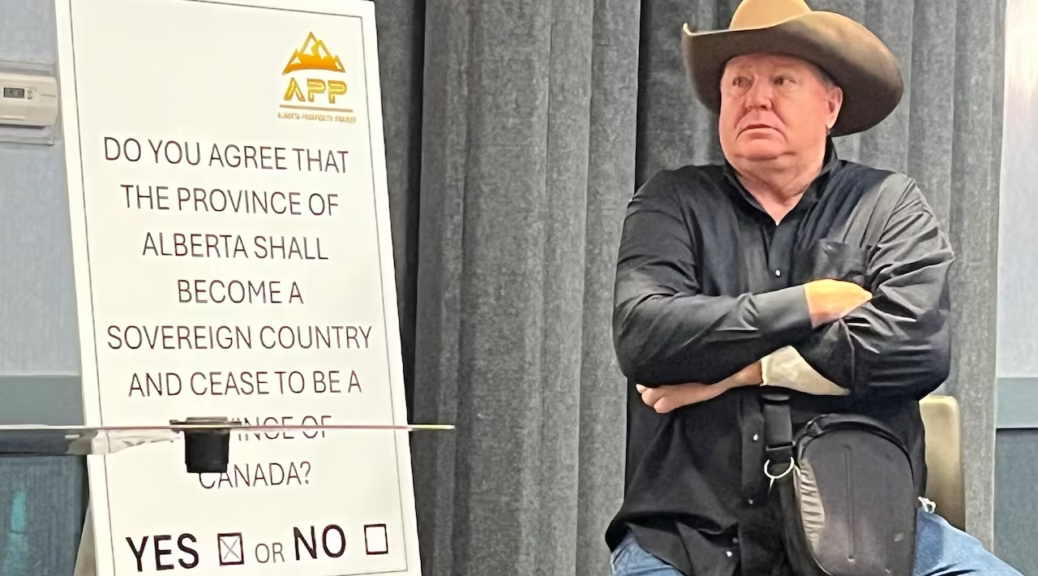
Alberta’s Separatists Have a Grievance List. It’s Not Much of One.
Alberta’s separatists want to leave Canada. That is a big ask. It would mean new borders, a new currency question, new trade arrangements, a new relationship with the United States, and a whole pile of constitutional, financial, and diplomatic problems that nobody has convincingly solved.
So what is the case for it?
Based on the movement’s own talking points, it is remarkably thin: pipelines, equalization payments, federal environmental policy, carbon pricing, immigration, and a general belief that Ottawa does not understand Alberta. Those are real political frustrations. Some are even legitimate. But they do not add up to a serious case for dissolving a country.
They add up to a tantrum.
Real Frustration, Small Recipe
Start with what Alberta separatists actually complain about. The province has long felt alienated from central Canada, particularly over oil and gas. Alberta believes it contributes more to the federal treasury than it receives back, and it resents policies that slow or block energy development. Recent years have added unstable oil prices, cancelled or delayed pipeline projects, job losses, and frustration over federal immigration policy.
Those grievances did not appear from nowhere. Western alienation has been part of Alberta politics for more than a century, and the province has repeatedly clashed with federal governments over resource control, energy policy, and the National Energy Program.
But “Ottawa annoys us” is not a nation-building platform. It is a complaint.
Every province has a version of it. British Columbia has its own frustrations with Ottawa. Saskatchewan has them. Newfoundland and Labrador has them. Quebec has had them so intensely that it held two referendums on sovereignty. The question is not whether Alberta has grievances. The question is whether those grievances are unusual, profound, or serious enough to justify separation.
They are not.
Compare It to Real Independence Movements
Look at recent referendums elsewhere and the difference becomes obvious.
Quebec’s sovereignty movement was built on language, culture, history, institutions, and a distinct national identity. Whatever you think of the project, it had depth. It was not simply “the federal government made a policy we dislike.” It was an argument that Quebec constituted a distinct society with its own collective future.
Scotland’s 2014 independence referendum involved years of argument over currency, pensions, oil revenue, defence, EU membership, borders, and the practical machinery of statehood. People could disagree fiercely with the Yes campaign, but it had to answer hard questions. What happens to the pound? What happens to pensions? What happens to trade? What happens to the border?
Catalonia’s push for independence was rooted in a long-standing Catalan identity, its own language, and a contested political relationship with Spain. Again, one could oppose it strongly, but it was not a movement built mainly on being annoyed by a national government’s energy policy.
Alberta’s separatist case, by comparison, often sounds like a list of policy complaints stapled to a flag.
The movement’s supporters point to economic frustration, especially in oil-dependent communities, and a feeling that Alberta sends more to Ottawa than it gets back. Fine. Make that argument. But then explain the country you are building. Explain the currency. Explain trade with the United States. Explain Indigenous treaty rights. Explain borders. Explain defence. Explain what happens to pensions, banking, interprovincial infrastructure, and the millions of Canadians who do not want to be expelled from their own country by a referendum.
The silence on those questions is telling.
“Whiny Little Babies” Is Harsh. But Not Wrong.
Here is the uncomfortable part: the separatist movement often comes across less like a mature independence campaign and more like a group of people who lost an argument and want to take their ball home.
They are not oppressed in any meaningful sense. Alberta is one of Canada’s wealthiest provinces. It has enormous resource wealth, strong institutions, representation in Parliament, and the ability to elect governments and shape national debates. Its premier can campaign against federal policy, challenge Ottawa in court, build coalitions with other provinces, and make the case for reform.
Instead, parts of the movement prefer the easier route: declare that Canada is hopeless, blame Ottawa for everything, and pretend that separation would magically fix the problem.
That is not courage. That is avoidance.
It is especially weak when the grievances are largely about money and policy preferences. A serious separatist movement says, “We are a distinct people with a distinct future, and we are prepared to accept the enormous costs of building a country.” Alberta’s version too often says, “We do not like the current federal government, so let’s blow up the country.”
That is not statesmanship. That is sulking with a flag.
The Immigration Obsession Makes It Worse
There is another problem: the movement is not only about oil and equalization. Some of its energy comes from immigration politics and culture-war resentment. Reporting on the referendum has noted that several ballot questions focus on immigration, with proposals aimed at reducing immigration and restricting access to public services for migrants.
That shifts the movement from “Alberta is economically mistreated” to something uglier: a politics of grievance, resentment, and scapegoating. And it makes the “freedom” language ring hollow. If your independence pitch depends on convincing people that newcomers are the problem, you are not offering liberation. You are offering a smaller, angrier, more exclusionary version of politics.
A Country Is Not a Consolation Prize
There is nothing inherently silly about separatism. Peoples around the world have made serious, sometimes persuasive cases for self-determination. But a serious case requires more than resentment.
It requires a positive vision. It requires answers to practical questions. It requires an honest accounting of costs. It requires a movement that can explain why breaking up Canada would make ordinary Albertans better off—not merely make some politicians feel more important.
Alberta separatists have not done that. They have assembled a short list of complaints, inflated it into a constitutional crisis, and called it freedom.
It is not freedom. It is a tantrum.
And if your grand plan for national independence boils down to “Ottawa was mean to our oil industry,” then yes: you come off less like founders of a new country and more like whiny little babies.
And one more thing: Everyone, except those who have a vested interest in the stuff, knows that fossil fuels are a diminishing return. The idiotic way the rest of Canada has had to coddle these tender rose petals in Alberta about this reality is frankly embarrassing. And it’s gone so far, and we’ve given them so much rope, this handful of MAGA-morons in power there trying to divide the country over it. When they are finally dispatched to the waste bin of history, can adults take over in that province, please? Maybe then they can help with the transition to green energy instead of making it impossible for this country to reach its climate goals.